Hundreds of coffins found in a Ptolemaic cemetery at Kom Abu Billo
An Egyptian mission has uncovered a cemetery with hundreds of stone and pottery coffins, gold amulets and ushabti figures at Kom Abu Billo, at the edge of Wadi El Natrun, dated mainly to the third and second centuries BC.
An Egyptian archaeological mission from the Supreme Council of Antiquities has uncovered a cemetery holding hundreds of coffins at Kom Abu Billo in Menoufia governorate, about an hour and a half north-west of Cairo. The site is the ancient city of Terenouthis, at the eastern entrance to Wadi El Natrun, a valley known in antiquity for natron, the salt used in mummification.
Hisham El-Leithy, secretary-general of the council, said it is the first find at the site with so many burials and coffins together in an open burial courtyard, and that parts of the structures still run under the sand and debris. A first look at the objects buried with the dead suggests the cemetery was used mostly by middle-class people rather than an elite. Tourism and Antiquities Minister Sherif Fathy said the variety of burial types, coffins and objects shows how important the site was.
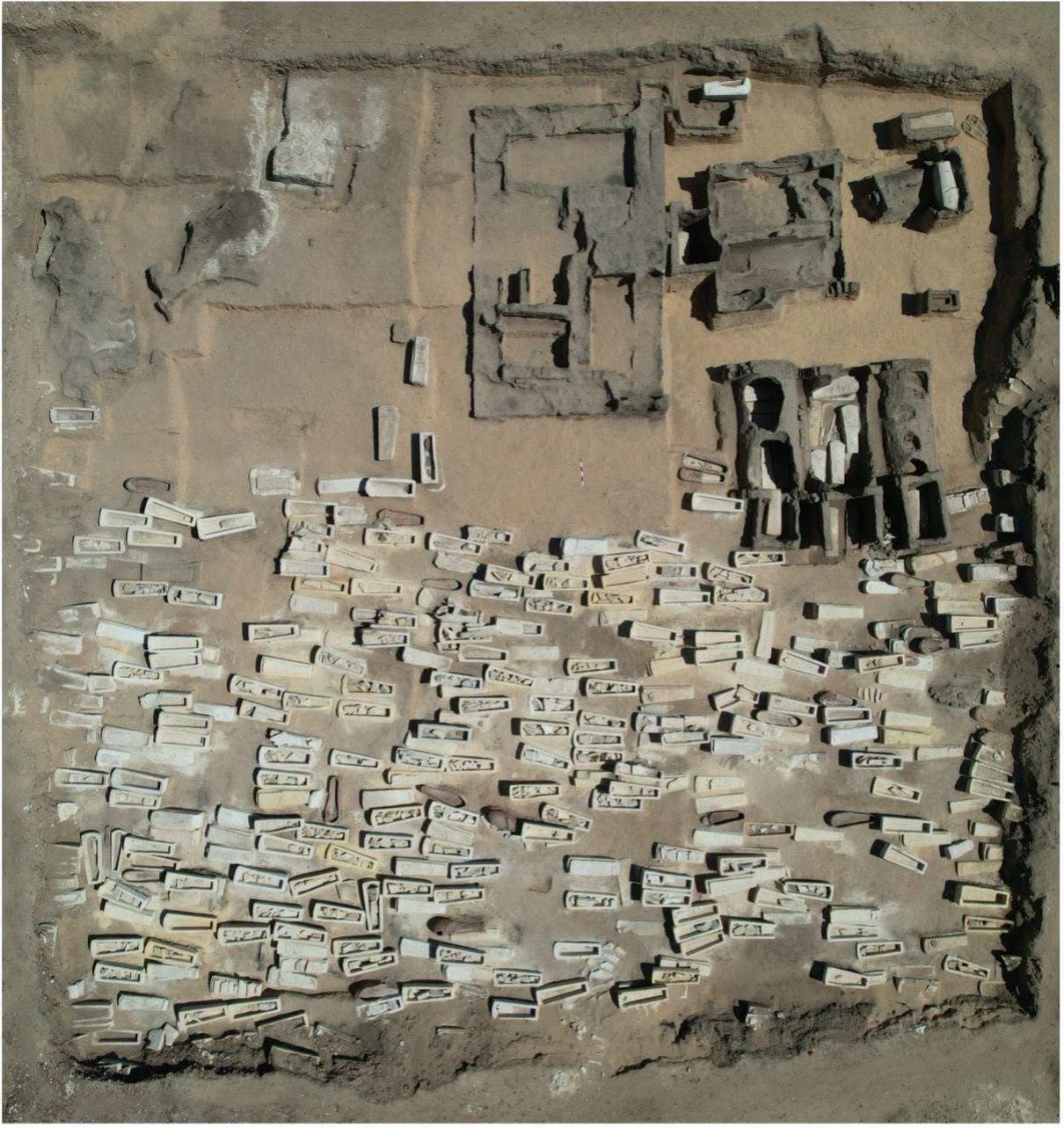
The surface layer alone held hundreds of limestone coffins. Some have no lids and others were smashed by looting and quarrying long ago. Alongside them the team found pottery coffins, some with stylised human features and some fully shaped like a body, as well as remains of wooden coffins, domed mudbrick tombs and one tomb lined inside with limestone. Mostafa Rizk, director general of antiquities in Menoufia, described the stone coffins of the surface layer and the pottery ones.
The bodies themselves are poorly preserved, but they still carry traces of embalming materials and resins, with layers of cartonnage and plaster painted yellow, red, blue and gold. The finds include gold tongues placed in the mouth, an earring, a gold necklace pendant and gold sheets, scarabs carved in schist and lapis lazuli, wedjat eyes and small amulets, and a large number of faience ushabti figures, some inscribed in hieroglyphs.
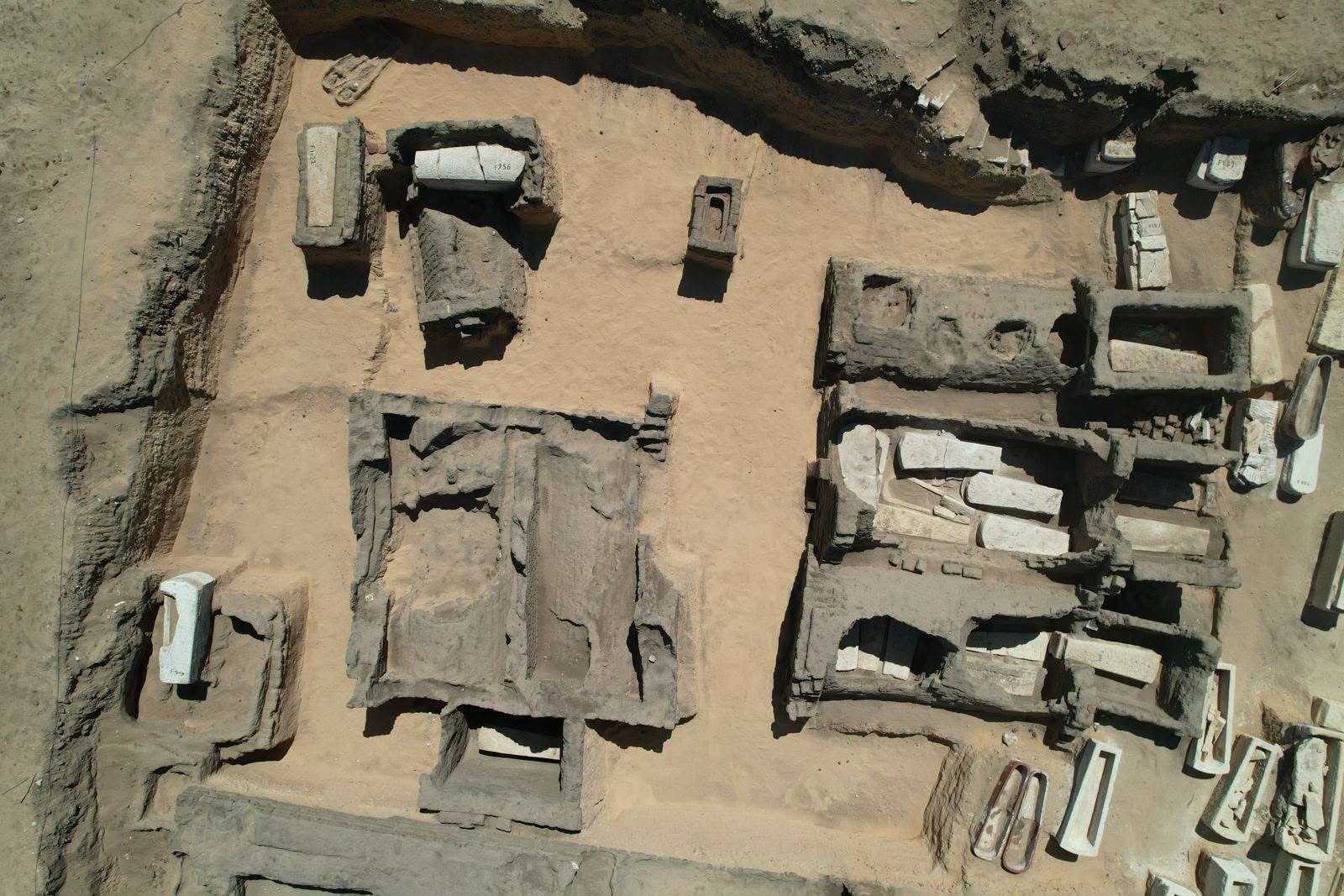
There were also offering tables, small limestone heads, sphinx figurines, fragments of stone statues of the falcon god Horus and two falcon burials. Several terracotta figures show Isis-Aphrodite, among them part of a vessel lid with the goddess seated on a lotus flower, nursing the infant Harpocrates.
Mohamed Abdel Badie, head of the Egyptian Antiquities Sector, said the first studies date the cemetery mainly to the early Ptolemaic period, the third and second centuries BC, with some burials from the end of the Late Period. The dating rests on the layers of the dig, the pottery, the style of the coffins, the burial customs and the tomb architecture. He said the burials reflect the worship of Renenutet, Osiris, Isis and Hathor, deities venerated in the area at different times. Earlier work at Kom Abu Billo had already found the remains of the town and a temple to Hathor, called Lady of Turquoise.
The officials gave no exact count of coffins, ushabti or amulets. The site is an active dig and is not open to visitors, and none of the finds has been put on display. Excavation, study and documentation will continue, and any later announcement on numbers or on where the objects will be shown will come from the Ministry of Tourism and Antiquities. Until then, the closest way to see coffins, ushabti and amulets of this period is in the Ptolemaic and Late Period galleries of the capital's museums.